








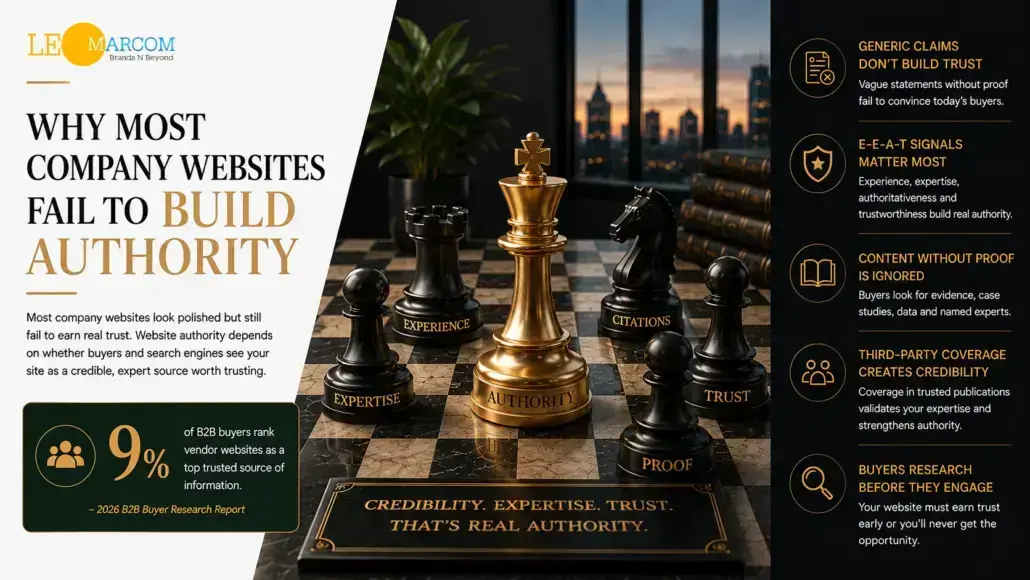
Most company websites look polished but still fail to earn real trust. Website authority is not about design quality or page speed alone. It depends on whether buyers and search engines see a site as a credible, expert source worth trusting.
Why Website Authority Remains So Hard to Build
According to a 2026 B2B buyer research report, only 9% of buyers rank vendor websites as a top trusted source of information. That number is striking given how much companies invest in their own sites. Buyers increasingly trust peer reviews, independent publications and expert commentary instead.
Generic homepage copy explains this gap clearly. Vague claims about being “industry-leading” or “innovative” carry no real proof. Consequently, buyers skip past self-promotional language and look elsewhere for validation.
What E-E-A-T Signals Actually Require
E-E-A-T signals stand for experience, expertise, authoritativeness and trustworthiness, Google’s core quality framework. Most company websites focus heavily on product pages while ignoring these deeper credibility markers. Named authors, documented expertise and cited data all strengthen these signals significantly.
Authority grows when real experts contribute visible insight, not anonymous marketing copy. Case studies with specific outcomes matter more than broad promises. Therefore, sites need proof points, not just polished language.
How Third-Party Coverage Fills the Authority Gap
A pharma company featured on worldpharmatoday.com gains independent validation that a self-published page cannot replicate. Similarly, a healthcare brand covered on hhmglobal.com benefits from editorial credibility outside its own domain.
The same principle extends further. A finance firm featured on worldfinanceinforms.com or an energy company covered on powerinfotoday.com builds authority through recognized industry sources.
Building Website Authority Across Every Sector
Telecom brands can strengthen this presence through teleinfotoday.com, while construction firms build credibility via worldconstructiontoday.com. Mining and packaging companies gain similar advantages through miningfrontier.com and packagingworldinsights.com.
Start by replacing vague claims with specific, verifiable proof. Next, name real contributors behind your expert content. Additionally, pursue independent coverage that supports what your own site already says.
Conclusion
Website authority cannot be designed into existence with better visuals alone. It requires proof, named expertise and independent validation working together. Brands that combine strong E-E-A-T signals with earned coverage build the trust their websites alone cannot deliver.
At Leo MarCom, we help pharma, healthcare, energy, telecom, finance, construction, mining and packaging brands build the website authority and E-E-A-T signals that turn visitors into confident buyers. Subscribe to our newsletter to get the latest industry updates.