





Buyers no longer take marketing claims at face value. The B2B trust gap has widened as promotional language keeps outpacing what companies can actually prove. Closing that gap now requires evidence, not better copywriting.
Why the B2B Trust Gap Keeps Widening
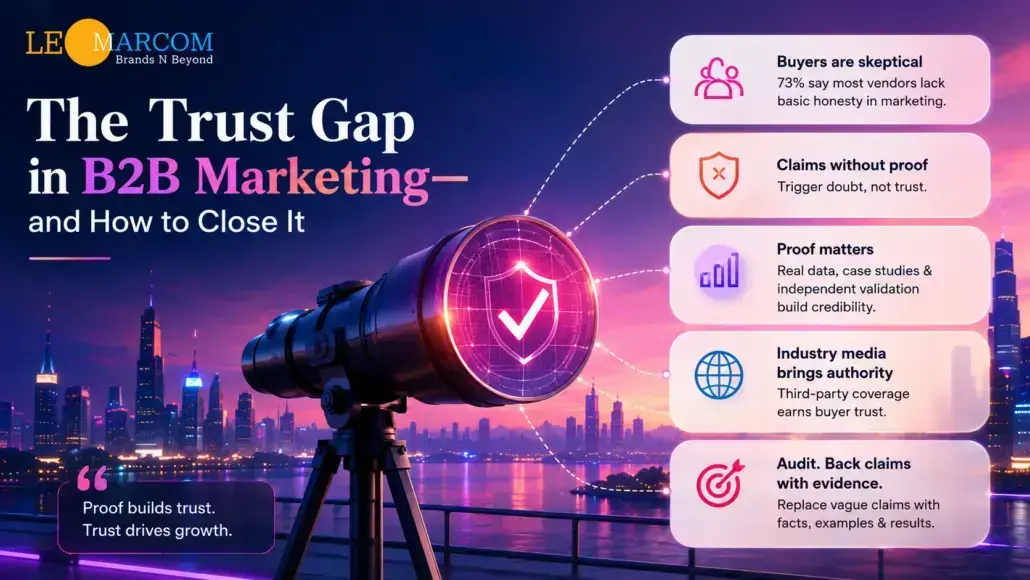
According to a 2025 industry survey covered by Sword and the Script, 73% of technology buyers say most vendors fall short of basic honesty in their marketing. That figure reflects years of inflated claims finally catching up with brand credibility. Buyers have grown skeptical by necessity, not by default.
Consequently, generic superlatives like “industry-leading” or “world-class” now trigger doubt instead of confidence. Buyers scan for evidence first and treat unsupported claims as a warning sign rather than reassurance.
What Proof-Based Marketing Actually Requires
Proof-based marketing replaces broad claims with specific, verifiable evidence. Named case studies, real numbers and independent validation all rebuild credibility that vague language has damaged. Therefore, every major claim needs a source, an example or a citation behind it.
This does not require perfection. Instead, it requires honesty about limitations alongside genuine strengths, since buyers trust brands that acknowledge trade-offs more than those claiming flawless performance.
How Industry Media Helps Close the Trust Gap
A pharma company featured on worldpharmatoday.com gains independent validation that self-published claims cannot replicate. Similarly, a healthcare brand covered on hhmglobal.com earns credibility through editorial context rather than marketing language alone.
The same principle applies elsewhere. A finance firm featured on worldfinanceinforms.com or an energy company covered on powerinfotoday.com closes its own trust gap through recognized, third-party coverage.
Building Proof-Based Marketing Across Every Industry
Telecom brands can strengthen this credibility through teleinfotoday.com, while construction and mining firms build it via worldconstructiontoday.com and miningfrontier.com. Packaging companies gain similar validation through packagingworldinsights.com.
Start by auditing your marketing for unsupported superlatives and vague claims. Next, replace each one with a specific fact, number or named example. Additionally, pursue independent coverage that supports what your own materials already say.
Conclusion
The B2B trust gap closes only through consistent, demonstrated proof, not more persuasive language. Proof-based marketing rebuilds the credibility buyers now demand before they engage seriously. Brands that commit to this shift earn attention skeptical buyers no longer give freely.
At Leo MarCom, we help pharma, healthcare, energy, telecom, finance, construction, mining and packaging brands build the proof-based marketing that closes the trust gap and earns real buyer confidence. Subscribe to our newsletter to get the latest industry updates.