







The short-form content vs long-form content debate is one of the most discussed topics in modern content marketing — and the answer is rarely straightforward. Both formats serve distinct purposes, reach different audience mindsets and perform differently depending on the platform, industry, and stage of the buyer journey.
Consequently, the most successful B2B content strategies in 2026 are not choosing one over the other — they are using both deliberately.
What Is Short-Form Content?
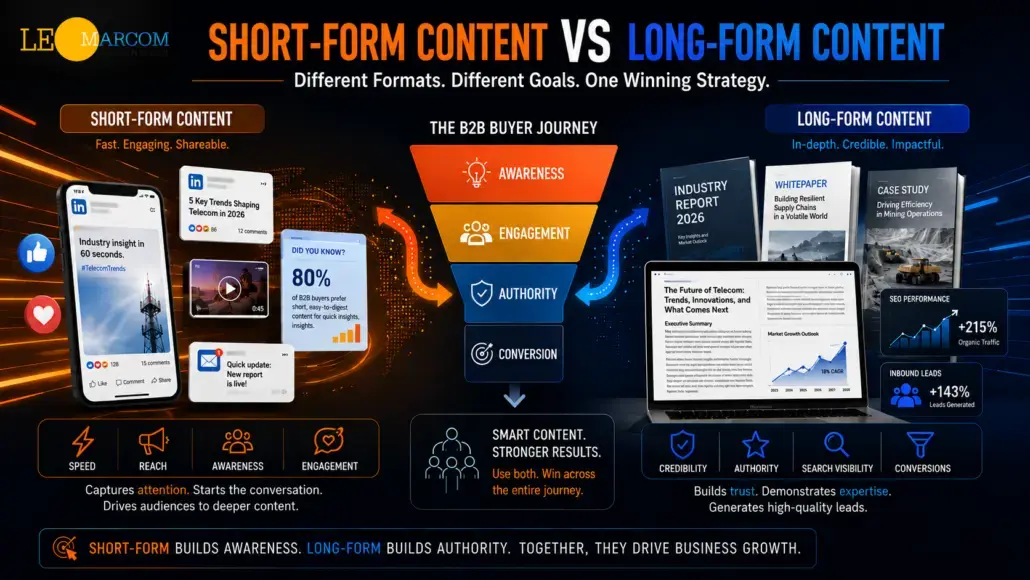
Short-form content includes social media posts, LinkedIn updates, email subject lines, short videos, infographics, and articles under 1,000 words. It is designed for fast consumption — delivering a single insight, idea or call to action quickly and clearly.
Furthermore, short-form content performs best at the top of the funnel — capturing attention, building brand awareness, and driving audiences toward deeper engagement. In fast-moving sectors like telecommunications and finance, where professionals consume information quickly, short-form content keeps brands visible and relevant between longer interactions.
What Is Long-Form Content?
Long-form content includes in-depth blog articles, whitepapers, industry reports, case studies, and guides exceeding 1,000 words. It is designed for audiences who are already engaged and seeking detailed knowledge to inform a decision.
Therefore, long-form content performs best at the middle and bottom of the funnel — building credibility, demonstrating expertise, and supporting the evaluation stage of a complex B2B buying cycle. Moreover, long-form content consistently outperforms short-form in organic search — generating more backlinks, ranking for more keywords and attracting higher-intent traffic over time.
When Short-Form Content Wins
Short-form content wins when speed, reach, and engagement are the priority. LinkedIn posts, short industry updates, and concise email campaigns are highly effective for maintaining brand visibility, sharing quick insights and driving traffic to deeper content.
In addition, short-form content is significantly easier to produce at scale — making it ideal for maintaining consistent publishing frequency across multiple platforms. For brands managing communications across industries as diverse as packaging, mining, and healthcare, short-form content keeps audiences engaged without overwhelming production resources.
When Long-Form Content Wins
Long-form content wins when credibility, authority, and search visibility are the priority. A well-researched industry report or detailed case study demonstrates expertise in a way that a LinkedIn post simply cannot.
As a result, B2B brands that invest in long-form content build stronger thought leadership positions and attract higher-quality inbound leads — particularly in sectors where purchasing decisions are complex, high-value and involve multiple stakeholders. Packaging World Insights and Mining Frontier both serve their professional audiences with in-depth industry content that supports exactly this kind of informed decision-making.
The Winning Strategy Combines Both
Short-form content vs long-form content is ultimately a false choice. The strongest B2B content strategies use short-form to build awareness and drive engagement and long-form to build authority and convert that engagement into business opportunities.
Furthermore, the two formats reinforce each other — a long-form industry report can generate weeks of short-form social content, while a series of short posts can build anticipation for a deeper piece of thought leadership.
Conclusion
Short-form content vs long-form content does not have a single winner — it has a smarter answer. Use short-form to stay visible. Use long-form to stay credible. Use both to build a B2B content strategy that works across the entire buyer journey.
At Leo MarCom, we help B2B brands across pharma, healthcare, energy, construction, mining, and packaging build content strategies that combine short and long-form formats for maximum impact. Subscribe to our newsletter to get the latest industry updates.