







01 · THE GREAT INVERSION
The Knowledge Paradox: From Scarcity to Overflow
[ Fig. 1 — The Great Inversion — Editorial Cartoon ]
Insert: leomarcom_fig1_great_inversion.svg
Ten years ago, knowledge management was fundamentally a retention problem. Organizations hemorrhaged institutional expertise through employee turnover, siloed departments, and the persistent failure to document what their people actually knew. The enterprise software industry responded with billions invested in knowledge base platforms, corporate intranets, and document management systems — all in service of one mission: capture knowledge before it walks out the door.
Then generative AI arrived — and inverted the problem entirely.
Today, the bottleneck is no longer creation. A single marketing team armed with AI writing tools can produce in one week what once took a full quarter. A B2B organization can generate whitepapers, blog posts, product newsletters, thought leadership pieces, and social content at industrial scale, often with reduced headcount. The volume problem is solved. The quality, consistency, and governance problem has barely been addressed.
This is what we call the Great Inversion. The challenge of 2015 was: “How do we capture what we know?” The challenge of 2025 is: “How do we govern what we publish?” The organizations that recognize this distinction — and build operational infrastructure around it — will define their markets in the decade ahead.
“The organizations that win will not be those who produce the most content. They will be those who govern their content ecosystems with the greatest strategic discipline — and have the domain authority to back it up.”
For business leaders, this shift demands a fundamental reorientation. Content is no longer a marketing support function — it is a core business asset, as consequential as talent acquisition, technology infrastructure, and capital allocation. In competitive B2B verticals, where purchase decisions are complex and buyer journeys extend across months, the organizations with the most authoritative, consistent, and strategically aligned content ecosystems consistently outperform competitors on every metric that matters: lead quality, sales cycle length, brand recall, and long-term customer retention.
02 · THE NUMBERS
The Content Explosion: Data That Demands Attention
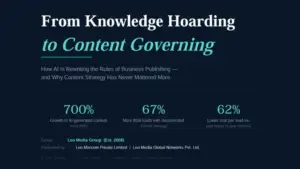
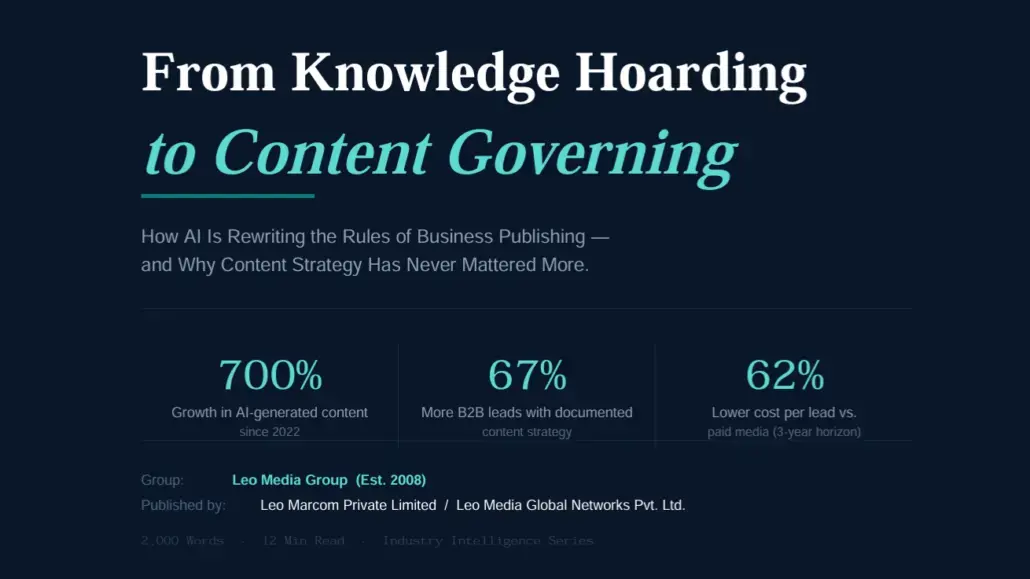
| 700%
Growth in AI-generated content since mainstream LLM adoption (2022–2025) |
3–7×
Content pieces B2B buyers consume before entering a sales conversation |
67%
More leads generated by companies with a documented content strategy |
62%
Lower cost per lead: organic content vs. paid advertising (3-year horizon) |
[ Fig. 2 — Knowledge & Content Strategy Evolution Timeline ]
Insert: leomarcom_fig2_timeline.svg
The numbers make the case more forcefully than any argument. Since the mainstream adoption of large language models in 2022 and 2023, the global volume of AI-generated digital content has grown by an estimated 700%. And yet, paradoxically, average content engagement rates across B2B digital channels have declined over the same period — a clear signal that the market is experiencing a quality crisis, not a quantity deficit.
[ Fig. 3 — Content Volume vs. Quality — The Great Divergence (Line Chart) ]
Insert: leomarcom_fig3_content_chart.svg
For B2B organizations specifically, the stakes are amplified. Research consistently shows that B2B buyers consume between three and seven pieces of content before initiating a sales conversation. These are not casual readers — they are decision-makers, procurement managers, and technical evaluators assessing expertise, credibility, and organizational fit. When the content they encounter is generic and indistinguishable from the AI-generated noise flooding every vertical, the brand has failed the buyer before the relationship even begins.
03 · STRATEGIC ARCHITECTURE
Content Strategy as the New Competitive Moat
[ Fig. 4 — Content Maturity Pyramid — Three B2B Tiers ]
Insert: leomarcom_fig4_pyramid.svg
Content strategy, in its most fundamental form, is the discipline of making deliberate decisions about what content an organization produces, for whom, and to what end. For most of the past two decades, it was treated as a communications support function — something the marketing team managed while the executive team focused on pipeline and revenue. Content was the middle layer: often underfunded, under-resourced, and under-strategized.
That framing is now obsolete. And organizations still operating under it are experiencing the consequences.
In a world where AI can flood any market vertical with competent, passable content in minutes, the organizations that have built genuine content ecosystems own the high ground. Their content is authoritative because it reflects accumulated domain expertise — not synthetic generation. It earns trust because it was produced for a specific professional audience with specific problems, not for an algorithm’s approval. And it compounds over time in ways that no paid media campaign can replicate.
KEY INSIGHT The most durable competitive moats in B2B markets are often invisible. A strategically governed content ecosystem — one that establishes an organization as the definitive knowledge source in its vertical — is among the highest-return long-term investments available to any business leader in 2025.
The content maturity pyramid reflects reality across B2B markets. At the base are organizations producing reactive, sporadic content with no editorial consistency or strategic alignment. In the middle are those with documented strategies but limited distribution reach or vertical depth. At the apex are those with fully integrated content ecosystems: owned publication platforms, dedicated industry vertical positioning, and consistent cadence that builds measurable authority over years, not months. The distance between the middle and the apex is not creativity. It is discipline, system, and sustained investment.
04 · THE UNIVERSAL FEED
Quality and Consistency: The Feed That Powers Both Worlds
[ Fig. 5 — The Dual Algorithm — Search + AI Diagram ]
Insert: leomarcom_fig5_dual_algorithm.svg
Here is the fundamental truth that both search engine algorithms and large language model architectures enforce with equal rigor: quality content, produced consistently, from recognized authoritative sources, wins. The platforms change; the algorithms evolve; the interfaces shift. The underlying signal remains constant — and has done so for over a decade.
Search engines invested years refining their ranking systems precisely to surface trustworthy, expert, and regularly updated content above the noise of the broader web. Google’s E-E-A-T framework — Experience, Expertise, Authoritativeness, and Trustworthiness — is a codified definition of what good B2B content should look like. Every major algorithmic update since 2018 has reinforced the same direction: reward depth, expertise, and consistency; penalize generic, shallow, and undifferentiated content regardless of volume.
Now add AI to the picture. As business users increasingly rely on AI assistants — through direct model queries or AI-enriched search results — the content surfaced in those responses is drawn from the same well that search engines have always prioritized: high-quality, structurally clear, thematically authoritative content from recognized sources. AI retrieval systems actively prefer content that is consistently formatted, topically coherent, and authoritative within a defined domain.
“Organizations building genuine content authority today are positioning themselves as the source material for AI-driven discovery systems that will increasingly mediate how B2B buyers find, evaluate, and trust potential partners.”
This creates a powerfully compounding dynamic. The organizations investing in quality, consistent content now become the reference material that AI models cite and surface. Organizations that flood the internet with undifferentiated content find themselves increasingly invisible — drowned in the volume of noise they themselves contributed to. The quality bar has risen, not fallen, in the age of AI.
05 · THE FRAMEWORK
The Content Governance Imperative
[ Fig. 6 — Content Governance Framework — Four Pillars ]
Insert: leomarcom_fig6_governance.svg
Content governance refers to the frameworks and systems an organization implements to ensure that its content output is aligned with strategic objectives, maintains consistent editorial standards, and is measured against defined performance outcomes. Effective content governance operates across four interconnected pillars:
Editorial Standards: The rules governing what gets published, who approves it, which sources are authoritative, and how brand voice is maintained across channels, contributors, and content types.
Distribution Intelligence: Systems determining where content is published, in what format, at what frequency, and through which platforms — based on audience behavior data, not assumption or instinct.
Technology Infrastructure: The tools managing production, review, scheduling, and performance tracking — increasingly AI-augmented, but always governed by human editorial judgment and strategic oversight.
Performance Loop: Analytics systems feeding performance data back into editorial decisions — measuring engagement, lead attribution, SEO outcomes, and brand sentiment across all content assets.
Organizations that implement all four governance pillars consistently outperform those that treat content as a spontaneous, campaign-driven activity. The difference is compounding: a well-governed content ecosystem improves with every publication cycle, while ungoverned content production tends to fragment, drift, and dilute brand authority over time.
06 · THE BUSINESS CASE
Making the Case: Content Strategy ROI in B2B Markets
[ Fig. 7 — Content Strategy vs Paid Media Only — ROI Bar Chart ]
Insert: leomarcom_fig7_roi_chart.svg
| 67%
More leads from B2B companies with documented content strategy |
62%
Lower cost per lead vs. paid media over a three-year window |
23%
Reduction in average B2B sales cycle length with consistent content |
5–6×
Higher conversion from content-educated organic leads vs. cold traffic |
The return on investment for strategic content marketing is among the most compelling in the B2B marketing toolkit — and among the most consistently misunderstood, because the payback curve is longer than most quarterly planning cycles accommodate. Organizations focused exclusively on short-term campaign attribution consistently underestimate the compounding value that strategic content investment delivers over a two to three-year horizon.
In B2B markets specifically, where purchase decisions are complex and buyer journeys span months, a consistently managed content ecosystem does something that paid advertising fundamentally cannot: it educates buyers before they enter the sales process. A prospect who arrives at a sales conversation having already engaged with six months of authoritative, expert content is not in the same position as one who clicked a banner ad. They arrive with context, trust, and alignment already built.
07 · CONCLUSION
The Next Chapter: Where Content Strategy Goes From Here
The organizations that will define their markets in the next decade are already building their content ecosystems today. They understand that the transition from knowledge scarcity to content overflow did not eliminate the need for expertise — it amplified it. In a world of infinite content production, the genuinely scarce resource is credibility: the kind built through years of consistent, authoritative, audience-focused publishing in defined industry verticals.
Content strategy is no longer a marketing support function. It is a core business asset — as important to long-term competitive positioning as talent acquisition, technology infrastructure, and capital allocation decisions. In B2B markets where purchase decisions are complex and stakes are high, a strategically governed content ecosystem is one of the highest-return long-term investments an organization can make.
THE CENTRAL PRINCIPLE Whether the reader is a human professional, a search engine algorithm, or an AI discovery model — only quality content, produced with strategic intent and maintained with consistency, commands sustained attention, builds genuine domain authority, and delivers measurable, compounding business value.
The question for every business leader is no longer whether to invest in content strategy. It is whether to start now — or spend the next three years trying to close the gap with organizations that already did.
ABOUT LEO MARCOM · B2B CONTENT AUTHORITY SINCE 2008
We’ve Been Building Content EcosystemsSince Before It Was Called That
Since 2008, Leo Marcom has operated at the intersection of B2B domain expertise and content strategy — before the discipline had its current name, before AI changed the rules, and before most organizations understood the compounding value of vertical publishing authority. What began as a commitment to serving specific industry sectors with genuine editorial depth has grown into a network of 17 dedicated B2B industry publications spanning pharmaceutical, healthcare, hospitality management, packaging, power generation, construction, textiles, manufacturing, and adjacent verticals.
Each publication functions as a focused content ecosystem: not just a digital property, but an active editorial environment with a defined professional audience, consistent publication cadence, and vertical positioning built and validated over 17 years.
| 17+
Active B2B industry publications across 8+ industry verticals |
17 yrs
Of B2B content strategy and media operation since 2008 |
~40%
European professional audience across the Leo Marcom network |
3
Core revenue streams: media partnerships, events, sponsored content |
Our Publication Network:
World Pharma Today · HHM Global · Packaging World Insights · Power Info Today · Pharma Advancement · Global Textile Times · Manufacturing Informs · World Construction Today · Tele Info Today · Mining Frontier · Oil & Gas Advancement · Transport Advancement · + more
What Leo Marcom Delivers:
- Vertical Content Authority — Access to established editorial environments with industry-specific credibility built over 17 years of focused B2B publishing, trusted by professionals in each sector.
- Content Strategy Direction — Objective strategic guidance from editorial planning and audience positioning to distribution architecture, governance frameworks, and performance measurement.
- Paid Partnership Integration — Sponsored content, media partnerships, and event promotions placed within authoritative editorial environments that B2B buyers actively seek out and trust.
- Content Marketing ROI — Defined content marketing outcomes aligned to your business objectives: pipeline contribution, brand authority metrics, and audience-building goals you can measure.
For B2B organizations navigating the AI-driven content landscape, Leo Marcom provides something that cannot be generated algorithmically: years of accumulated domain credibility, an established professional audience network across specific industry verticals, and the strategic expertise to translate content investment into measurable, trackable business outcomes.
Leo Marcom provides the right direction and objective through our dedicated industry platforms and magazines — helping B2B organizations achieve the content marketing ROI that only vertical authority and strategic consistency can deliver.
Click here to download the pdf : https://drive.google.com/file/d/1ZFRmF0fGWKUp5IfBxmCVFAJtoJHT0agl/view?usp=sharing