








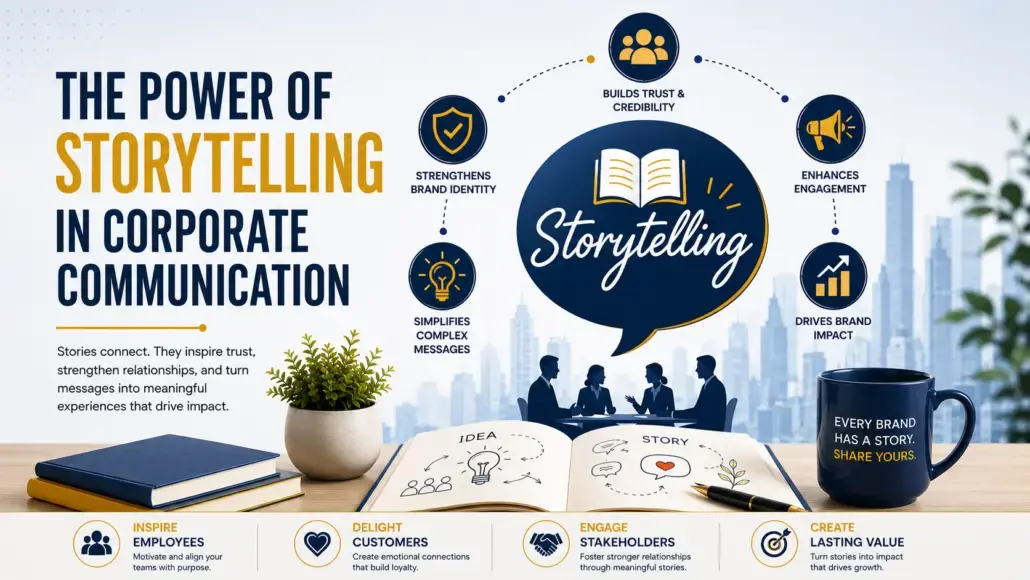
Storytelling in corporate communication has become one of the most powerful tools a business can use to build trust, engage audiences, and communicate its values with real impact. In fact, in a world where decision-makers are overwhelmed with information, a compelling story is often what separates a memorable brand from a forgettable one.
Businesses that communicate through stories do not just share information — they create connection.
Why Storytelling in Corporate Communication Works
People are hardwired to respond to stories. Consequently, when businesses frame their communication as a narrative rather than a formal message, audiences engage more deeply and remember more clearly.
Furthermore, storytelling allows companies to simplify complex ideas, humanise their brand, and communicate values in a way that statistics and formal reports cannot. For B2B companies in particular — where long buying cycles and multiple stakeholders are the norm — emotional resonance plays a significant role in building trust and influencing decisions.
Building Brand Identity Through Story
A strong brand is not just a logo or a tagline. It is the story a company tells consistently across every touchpoint. Storytelling in corporate communication helps businesses:
- Communicate their mission and purpose clearly
- Share client success stories that demonstrate real impact
- Highlight innovation, expertise, and industry knowledge
- Build authentic connections with customers and partners
- Differentiate themselves in competitive markets
Moreover, businesses that share genuine stories — about their journey, their challenges, and their people — are perceived as more trustworthy and credible than those that rely purely on promotional messaging.
Storytelling in Internal Communication
Storytelling is equally powerful inside an organisation. Leaders who communicate through stories inspire teams more effectively than through data alone. Therefore, whether it is sharing a vision for the future, recognising team achievements, or navigating change, narrative-driven communication strengthens workplace culture and improves employee engagement.
When employees understand the story of where a company is going and why, they become more invested in helping it get there.
Digital Platforms Have Amplified the Power of Story
The rise of digital media has given businesses more ways than ever to tell their stories. Blogs, LinkedIn posts, video content, podcasts, and social media all provide channels through which corporate narratives can reach wider professional audiences.
In addition, visual storytelling — through video, infographics, and case study content — captures attention quickly and encourages deeper engagement. As a result, businesses that combine strong storytelling with a consistent digital content strategy achieve better brand visibility and stronger audience relationships over time.
According to Nielsen, content that tells a story generates significantly higher audience recall than content that simply presents information.
Conclusion
Storytelling in corporate communication is not a creative luxury — it is a strategic necessity. In a competitive digital landscape, the brands that connect emotionally, communicate authentically, and tell their story consistently are the ones that build lasting trust and loyalty.
At Leo MarCom, we help B2B brands across pharma, healthcare, energy, construction, and manufacturing develop communication strategies that combine expert content with powerful storytelling. Subscribe to our newsletter to get the latest industry updates.