








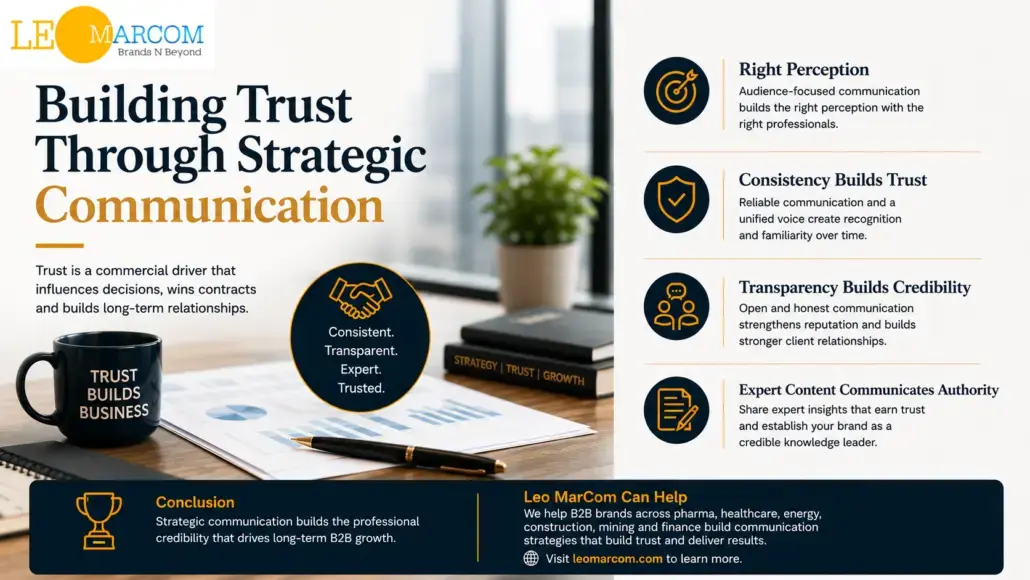
Building trust through strategic communication is the single most important investment a B2B brand can make in 2026. In markets where purchasing decisions involve significant financial commitment, long evaluation periods and multiple stakeholders, trust is not a soft metric – it is a commercial driver that directly influences whether a business wins contracts, attracts partners and retains clients over the long term.
Consequently, brands that communicate strategically and consistently build a compounding trust advantage that their competitors find increasingly difficult to close.
What Strategic Communication Actually Means
Strategic communication is not simply talking more or publishing more content. It is the deliberate, consistent and audience-focused approach to every message a brand sends — ensuring that tone, expertise, platform and frequency all work together to build the right perception with the right professional audience.
Furthermore, strategic communication requires clarity of purpose at every touchpoint — from the company website and LinkedIn presence to email campaigns, industry publications and client-facing materials. Every interaction either builds or erodes trust and the brands that understand this treat communication as a core business function rather than a marketing afterthought.
Consistency Is the Foundation of Trust
Professional audiences build trust through repeated, reliable exposure to a brand. Therefore, businesses that communicate consistently — publishing regularly, maintaining a unified brand voice and showing up across multiple channels — build recognition and familiarity that compounds over time.
Moreover, inconsistency is one of the fastest ways to undermine credibility. A brand that publishes sporadically, shifts its messaging or goes silent between campaigns signals instability — exactly the opposite of what B2B decision-makers look for in a long-term partner. World Finance Informs and Tele Info Today demonstrate consistent communication in action — delivering reliable expert content to their professional audiences week after week and building the readership loyalty that inconsistent publishing never achieves.
Transparency Builds Deeper Credibility
In B2B markets where stakes are high and relationships are long-term, transparency is not just appreciated — it is expected. Brands that communicate openly about their expertise, their processes and even their limitations are consistently perceived as more trustworthy than those that present only a polished promotional surface.
In addition, transparent communication during challenges — responding to difficulties quickly, honestly and professionally — protects brand reputation far more effectively than silence or defensive messaging. As a result, businesses that communicate with integrity in difficult moments often emerge with stronger client relationships than they had before.
Expert Content Communicates Authority
Building trust through strategic communication requires brands to demonstrate genuine knowledge — not just assert it. Therefore, publishing expert content that addresses real industry challenges, interprets market developments and shares original insight is one of the most powerful trust-building tools available.
HHM Global, World Pharma Today and Power Info Today all build trust with their professional audiences through exactly this approach — publishing verified, expert-driven content that decision-makers rely on for real business intelligence. Brands that contribute to or advertise within these platforms inherit the trust those publications have earned.
Multi-Platform Presence Reinforces Trust
A brand that appears consistently across multiple credible channels — its own website, LinkedIn, industry publications, email newsletters and sector-specific media platforms — signals stability, authority and genuine commitment to its professional community.
Consequently, multi-platform strategic communication creates multiple trust-building touchpoints that reinforce each other — ensuring a brand stays visible and credible throughout an entire buying cycle regardless of where a prospect begins their research.
Conclusion
Building trust through strategic communication is not a campaign — it is a commitment. Brands that communicate with consistency, transparency and genuine expertise across every channel they own and every platform their audience trusts will build the kind of professional credibility that drives long-term B2B growth.
At Leo MarCom, we help B2B brands across pharma, healthcare, energy, construction, mining and finance develop strategic communication strategies that build lasting trust and deliver measurable business results. Subscribe to our newsletter to get the latest industry updates.